
In today's manufacturing environment, precision is directly linked to product quality, assembly efficiency, and long-term reliability. Whether producing automotive components, industrial machinery parts, marine equipment, or medical device components, manufacturers are under constant pressure to meet tighter tolerances, shorter lead times, and higher quality standards.
At the same time, modern projects often require more than just machining. Components may need to go through casting or forging, CNC machining, heat treatment, surface finishing, and final inspection before reaching the customer.
Managing these processes across multiple suppliers can increase lead times, create communication challenges, and introduce quality inconsistencies. This is where choosing the right manufacturing partner becomes critical.
At BING FENG INDUSTRIAL CO., LTD., we provide integrated manufacturing solutions that combine casting and forging capabilities, precision CNC machining, heat treatment services, surface finishing processes, and OEM/ODM project support.
By integrating multiple manufacturing processes under one supply chain, we help customers simplify sourcing, improve production efficiency, and maintain consistent quality from raw material to finished component.
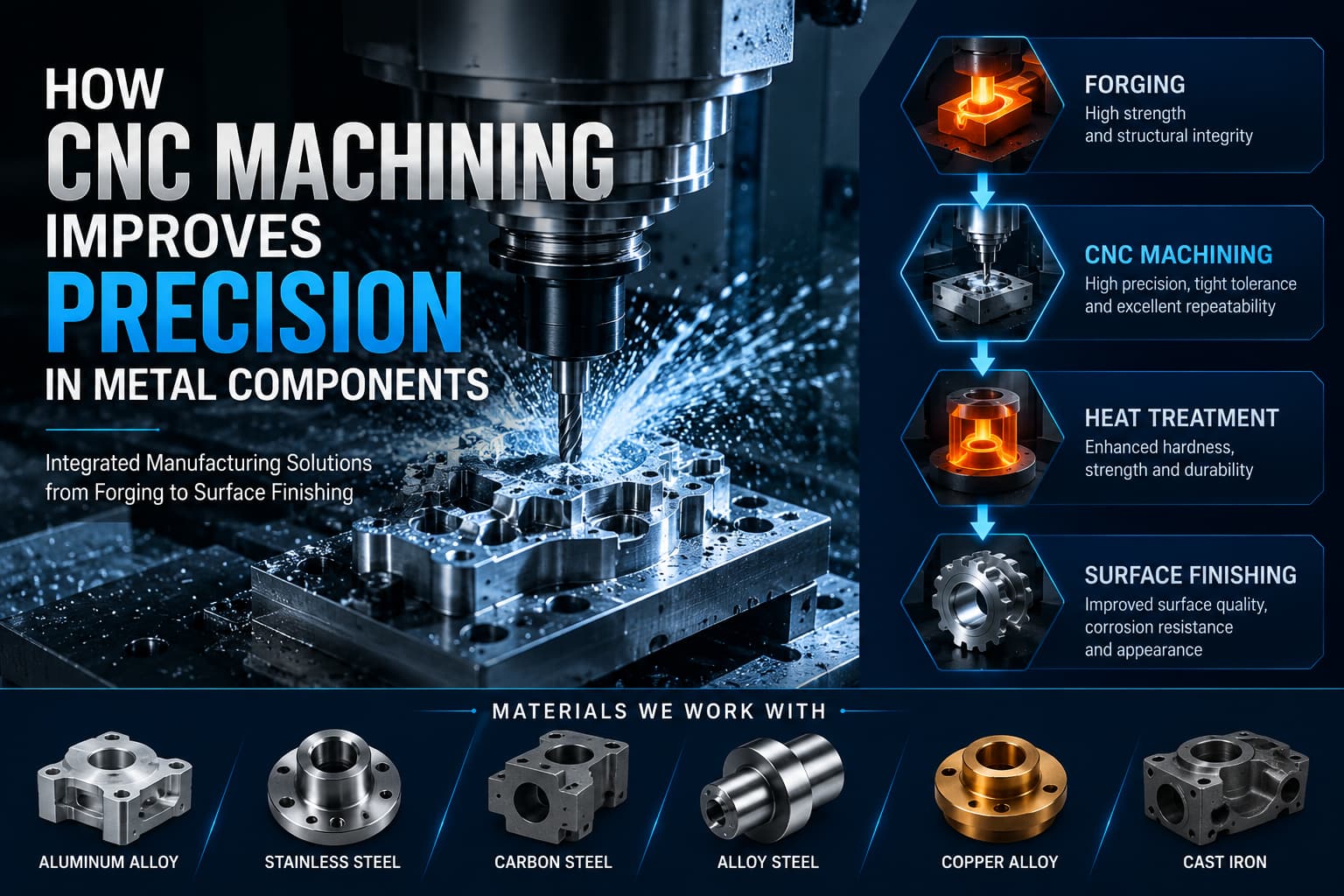
Our manufacturing capabilities support a wide range of materials, including aluminum alloy, copper and copper alloys, stainless steel, carbon steel, alloy steel, special alloy steel, and cast iron. This flexibility allows us to support customers across industries such as automotive, industrial machinery, construction equipment, marine applications, food processing equipment, and medical devices.
Why Manufacturers Are Moving Toward Integrated CNC Manufacturing
Many machining suppliers focus solely on machining operations. However, modern OEM projects often require multiple manufacturing processes before a component is ready for assembly.
A typical production workflow may include:
Casting or Forging → CNC Machining → Heat Treatment → Surface Finishing
When these processes are managed by different suppliers, manufacturers often face longer lead times, increased communication costs, quality inconsistencies, supply chain risks, and more complicated project management.
By working with an integrated manufacturing partner, companies can streamline production, improve quality control, and reduce overall project complexity.
Why Precision Matters in Metal Components
Precision affects far more than dimensions alone. It directly influences product performance, assembly efficiency, and component lifespan.
For example, automotive transmission components require accurate dimensions to ensure smooth power transfer. Machinery components depend on tight tolerances to reduce vibration and wear. Medical equipment parts require precision for functionality and safety. Marine and industrial equipment components must maintain reliability under demanding operating conditions.
Even a small dimensional deviation can lead to assembly problems, increased maintenance costs, and reduced product performance.
How CNC Machining Improves Precision
Computer-Controlled Accuracy
One of the greatest advantages of CNC machining is its ability to eliminate many of the variables associated with manual machining.
Using programmed instructions, CNC machines follow precise cutting paths and machining parameters throughout the production process. This provides consistent dimensions, reduced human error, improved repeatability, and stable production quality.
For manufacturers producing large quantities of components, this consistency is essential.
Tighter Tolerances
Many industrial components require extremely precise tolerances to function properly. CNC machining enables manufacturers to maintain dimensional accuracy across multiple production batches.
| Application | Why Precision Matters |
|---|---|
| Shafts & Bearings | Proper fit and smooth operation |
| Gears | Accurate tooth engagement |
| Hydraulic Components | Leak prevention and pressure control |
| Automotive Parts | Assembly consistency and performance |
Maintaining tight tolerances reduces assembly issues and improves overall product reliability.
Improved Geometric Consistency
Modern components often include multiple critical features such as holes, grooves, threads, complex surfaces, and precision mating features.
CNC machining allows these features to be produced accurately and consistently, improving concentricity, perpendicularity, hole positioning accuracy, and surface profile consistency.
This is particularly important for precision assemblies and moving mechanical systems.
Better Surface Quality
Surface quality can significantly impact component performance. High-quality machined surfaces can contribute to reduced friction, improved wear resistance, better sealing performance, and enhanced appearance.
In many cases, improved surface quality also reduces the need for additional finishing operations.
Excellent Repeatability for Production Runs
Many manufacturers face challenges when transitioning from prototype development to mass production.
CNC machining provides excellent repeatability because machine programs can be reused across multiple production runs. Benefits include consistent quality, lower scrap rates, improved productivity, and simplified quality control.
For OEM projects, repeatability is often just as important as initial precision.
Material Selection Also Impacts Precision
Achieving precision requires not only advanced machining equipment but also proper material selection.
BING FENG supports a variety of engineering materials to meet different application requirements.
| Material | Key Advantages |
|---|---|
| Aluminum Alloy | Lightweight and corrosion resistant |
| Stainless Steel | Corrosion resistance and durability |
| Carbon Steel | Cost-effective and versatile |
| Alloy Steel | High strength and wear resistance |
| Special Alloy Steel | High-performance applications |
| Copper Alloys | Excellent conductivity |
| Cast Iron | Vibration damping and wear resistance |
Different materials require different machining strategies, cutting parameters, and tooling selections. An experienced manufacturing partner understands how to optimize both material and process selection to achieve the desired result.
Beyond CNC Machining: Additional Processes That Support Precision
CNC machining is often only one part of a complete manufacturing solution.
Heat Treatment
Heat treatment can improve hardness, strength, wear resistance, and fatigue life. This is particularly important for carbon steel, alloy steel, and special alloy steel components.
Surface Finishing
Surface finishing can enhance corrosion resistance, appearance, surface durability, and friction performance. Examples include plating, polishing, coating, and other specialized treatments.
Casting and Forging
For many industrial components, machining begins with a casting or forging process that provides the required structural properties. Combining these processes allows manufacturers to achieve both mechanical strength and dimensional precision.
Why Choosing the Right CNC Machining Partner Matters
Advanced equipment alone does not guarantee precision. A reliable manufacturing partner should also provide engineering expertise, material knowledge, process integration, quality control systems, and stable production capacity.
At BING FENG INDUSTRIAL CO., LTD., we combine casting and forging, CNC machining, heat treatment, and surface finishing under one manufacturing platform.
This integrated approach allows us to help customers reduce supply chain complexity, improve manufacturing efficiency, and maintain consistent quality throughout the entire production process.
Conclusion
Precision is a critical requirement in today's manufacturing industry, and CNC machining plays a key role in achieving it.
Through computer-controlled accuracy, tight tolerances, excellent repeatability, and superior surface quality, CNC machining enables manufacturers to produce reliable components for demanding applications.
When combined with integrated processes such as casting, forging, heat treatment, and surface finishing, CNC machining becomes part of a complete manufacturing solution that supports product quality, production efficiency, and long-term business success.
For companies seeking a trusted manufacturing partner, working with an experienced supplier that offers integrated production capabilities can provide significant advantages in both quality and supply chain management.
FAQ
What industries commonly use CNC machining?
Industries such as automotive, industrial machinery, marine equipment, construction equipment, food processing equipment, and medical devices all rely on CNC machining to produce precision metal components.
What materials can be CNC machined?
Common materials include aluminum alloys, copper alloys, stainless steel, carbon steel, alloy steel, special alloy steel, and cast iron.
Why are tight tolerances important?
Tight tolerances help ensure proper assembly, consistent product performance, reduced wear, and improved reliability.
Can CNC machining support both prototypes and production runs?
Yes. CNC machining is widely used for prototype development, low-volume production, and large-scale manufacturing due to its accuracy and repeatability.
Why choose an integrated manufacturing supplier?
An integrated supplier can provide casting, forging, machining, heat treatment, and surface finishing services under one supply chain, helping reduce lead times, simplify communication, and improve overall quality consistency.