Support

2026/07/16
Spline shafts are used to transmit torque between a shaft and mating components such as hubs, gears, couplings, clutch components, and other rotating parts. They are widely used in automotive drivetrains, motorcycles, industrial machinery, construction equipment, and other power transmission systems.
Although the spline is only one functional feature of a shaft, the selected manufacturing method can affect tooth profile accuracy, surface condition, dimensional stability, material utilization, tooling cost, production efficiency, and long-term quality consistency.
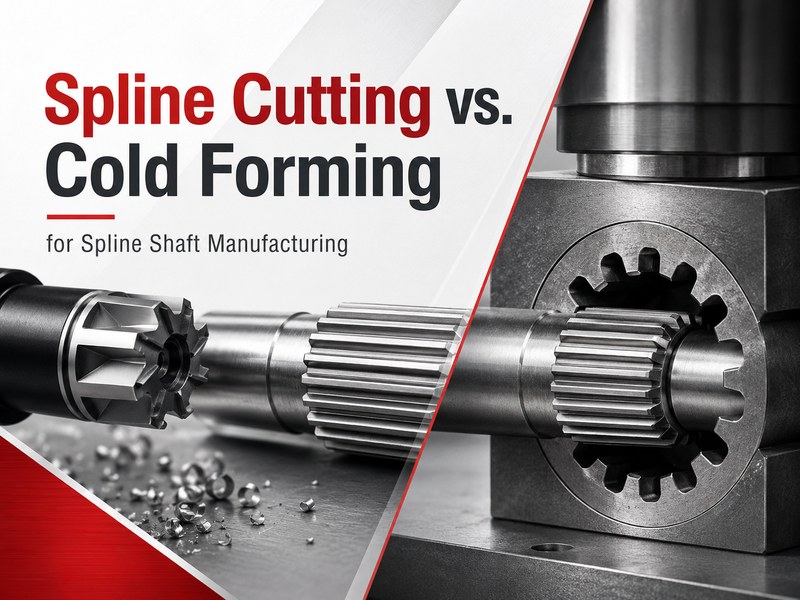
Two methods commonly compared in spline shaft manufacturing are spline cutting and cold forming. Spline cutting removes material to create the required tooth profile, while cold forming applies pressure to plastically deform the material into the required shape.
In general, spline cutting is well suited to prototypes, low-volume production, design changes, and complex geometries. Cold forming may offer advantages in stable production programs when the material, spline geometry, tooling conditions, and production volume are suitable.
BING FENG INDUSTRIAL CO., LTD. has manufacturing experience with gear shafts, axles, long shafts, ATV rear axles, heavy motorcycle rear axles, and drive shafts, as well as other precision shaft-related components.
Based on its experience in precision metal parts manufacturing, CNC machining, heat treatment, surface finishing, and dimensional inspection, this article explains the main factors engineers and purchasing professionals should review when comparing spline cutting with cold forming.
The final manufacturing method and production feasibility should always be evaluated according to the drawing, material, dimensional tolerances, component geometry, production volume, and available manufacturing equipment.
Spline cutting is suitable for prototypes, products that may require design changes, multiple part specifications, low-volume production, special geometries, and materials that are difficult to plastically form.
Cold forming is more suitable when the design is finalized, repeat orders are expected, blank dimensions and material conditions are stable, and the tooling investment can be justified by production volume.
A spline shaft has multiple teeth or grooves that engage with the internal spline of a mating component. This engagement transmits torque while maintaining the rotational relationship between the connected components.
Reliable operation depends on more than the shaft diameter. Tooth thickness, pitch, tooth profile, positional accuracy, surface condition, fit, and engagement with the mating component must also be properly controlled.
The manufacturing method can affect:
Selecting a manufacturing method simply because it appears faster, stronger, or less expensive can create problems during production or under actual operating conditions.
A proper decision requires a combined review of operating torque, load conditions, material, spline geometry, dimensional tolerances, heat treatment requirements, prototype quantity, and expected annual production volume.
No single spline manufacturing method is always superior for every application. The appropriate method is the one that meets the required performance, quality, volume, and total cost while keeping manufacturing risk within an acceptable range.
Spline cutting creates the required tooth profile by removing material from a previously prepared shaft blank.
Depending on the spline type, part geometry, accuracy requirements, and available equipment, common cutting processes may include:
The appropriate process depends on whether the spline is internal or external, the component geometry, material, required accuracy, production quantity, and the manufacturer’s available equipment.
One of the main advantages of spline cutting is its flexibility when responding to design changes.
If the tooth profile, shaft dimensions, or engagement conditions change during product development, a cutting process may allow the manufacturer to adjust the machining program or tooling without producing an entirely new forming die.
However, spline cutting requires proper control of cutting tool condition, machine rigidity, workholding stability, tool runout, machining parameters, workpiece alignment, burr formation, and chip evacuation.
If these factors are not properly controlled, the result may include tooth thickness variation, poor root surface condition, profile errors, excessive runout, burrs, or improper engagement with the mating component.
Cold forming creates the spline profile by applying pressure to a shaft blank and plastically deforming the material.
Instead of removing material as chips, the process displaces the material until the required tooth profile is formed.
Depending on the selected process, the spline may be formed by pressing or rolling the material with dedicated tooling.
These characteristics can make cold forming advantageous for production programs with stable designs and consistent manufacturing conditions.
However, the process is strongly affected by material ductility, initial hardness, blank dimensions, tooling geometry, forming pressure, lubrication, equipment stability, die wear, spline length, and tooling access around adjacent features.
If material flow is not properly controlled, possible problems include incomplete tooth filling, surface damage, dimensional variation, excessive forming loads, and reduced tool life.
Cold forming normally requires dedicated tooling. If the spline geometry changes, the tooling may need to be modified or completely replaced.
For this reason, cold forming is most suitable when the design, material, blank dimensions, and production quantity are stable.
| Evaluation Factor | Spline Cutting | Cold Forming |
|---|---|---|
| Manufacturing principle | Removes material to create the spline profile | Plastically deforms material with dedicated tooling |
| Initial tooling cost | Generally easier to apply to flexible and low-volume production | May require a higher initial investment in dedicated tooling |
| Design changes | Generally easier to accommodate | May require tooling modification or replacement |
| Prototype production | Well suited to development and prototype quantities | Often less economical for small quantities due to tooling cost |
| Mass production | Possible, but machining time and tool wear must be considered | Can be efficient after the process is fully established |
| Material utilization | Produces chips through material removal | Uses material efficiently and generates fewer chips |
| Material conditions | Can accommodate a broad range of machinable materials | Strongly affected by ductility, hardness, and blank condition |
| Geometry flexibility | Generally provides greater design flexibility | Limited by tooling access and material formability |
| Surface condition | Affected by tool condition and cutting parameters | Affected by tooling accuracy, lubrication, and material flow |
| Best suited production conditions | Prototypes, design changes, multiple specifications, and low-to-medium volume | Stable designs, repeat orders, and sufficient production volume |
This comparison is not an absolute rule for every project.
Even a high-volume component may require spline cutting if its geometry, material, or tolerance requirements are not suitable for cold forming. Cold forming may also be inappropriate when the product design has not been finalized.
The final decision should be based on both technical feasibility and the total cost of the complete production program.
A cold-formed spline is not automatically stronger than a cut spline in every application.
Cold forming may change the material properties around the formed area through work hardening. However, the final strength and durability of a spline shaft also depend on many other factors.
A cut spline can also achieve high durability when the tooth profile, surface condition, heat treatment, and dimensional accuracy are properly controlled.
A complete spline shaft manufacturing process may include material selection, blank preparation, CNC turning and milling, spline machining, heat treatment, straightening or finishing, surface finishing, and dimensional inspection.
Heat treatment can increase hardness and wear resistance, but it may also cause distortion or runout. Machining allowances, post-heat-treatment finishing, and final inspection methods should therefore be planned before production begins.
Spline shaft strength is the combined result of material, tooth geometry, machining accuracy, heat treatment, surface condition, alignment, and actual operating loads. The method used to create the spline is only one part of the complete performance equation.
Production volume is an important cost factor, but it should not be evaluated separately from material and component geometry.
Even if the machining time per part is longer, spline cutting may remain the more practical option during product development or flexible production because it avoids a large initial tooling investment.
There is no universal break-even quantity that applies to every spline shaft.
Economic feasibility depends on part size, spline length, tooth profile, material, tooling complexity, tool life, die life, secondary operations, inspection requirements, and annual demand.
Engineers should determine whether the spline is internal or external, straight or helical, and confirm the tooth count, module or diametral pitch, pressure angle, major diameter, minor diameter, effective spline length, root geometry, adjacent shoulders, material hardness, heat treatment, tolerances, and surface roughness.
Purchasing professionals should therefore compare not only the quoted unit price, but also manufacturing feasibility and the total cost of the complete project.
Shaft diameter and overall length alone are not enough to prepare an accurate spline shaft quotation.
When requesting a quotation from a spline shaft manufacturing source or precision metal parts supplier, provide the following information:
Expected annual demand is particularly important when comparing spline cutting with cold forming. Without a clear production quantity, it is difficult to determine whether an investment in dedicated forming tooling is economically justified.
Buyers should also identify which dimensions are functionally critical and which features may be adjusted to improve manufacturability.
Providing complete technical and production information allows the supplier to evaluate manufacturing feasibility, tooling, lead time, inspection requirements, production risk, and total cost more accurately.
BING FENG INDUSTRIAL CO., LTD. provides precision metal parts manufacturing and integrated production services for prototypes, small batches, and mass production programs.
Its main product categories include:
Its integrated manufacturing services include:
Available materials include high-carbon steel, alloy steel, stainless steel, copper, aluminum, titanium, and cast iron.
BING FENG operates 36 production machines and uses inspection equipment that includes a ZEISS coordinate measuring machine. The company obtained ISO 9001 quality management system certification in 2005.
For shaft-related projects, it is important to evaluate the complete component rather than only one feature. Journals, bearing mounting areas, shoulders, gear teeth, concentricity, runout, heat treatment, mating engagement, and inspection requirements can all affect assembly and operating performance.
This article compares spline cutting and cold forming as general manufacturing methods. The feasibility of any individual spline shaft project should be determined after reviewing the drawing, material, dimensional tolerances, production quantity, and other project requirements.
BING FENG evaluates each inquiry according to the customer’s drawing, material requirements, production quantity, quality standards, and final application to determine manufacturing feasibility and an appropriate production process.
Spline cutting offers flexibility and is well suited to prototypes, design changes, special parts, and low-to-medium-volume production.
Cold forming can provide high material utilization and efficient mass production when the material, geometry, tooling, and production quantity are appropriate.
The most important point is not to select a process based only on its name. Product requirements, manufacturing feasibility, initial investment, production cost, and quality control requirements should be evaluated together.
BING FENG reviews the complete manufacturing requirements, including material, component geometry, machining, heat treatment, surface finishing, dimensional inspection, production quantity, and final application.
No. Cold forming can provide high material utilization and efficient mass production when the conditions are suitable. Spline cutting may be more appropriate for prototypes, design changes, special geometries, low-volume production, and materials that are difficult to plastically form.
Yes. Spline cutting can be used for mass production when the machining cycle time, tool life, material machinability, required accuracy, and total manufacturing cost satisfy the project requirements.
It may be technically possible, but dedicated tooling can make cold forming less economical for small prototype quantities. Spline cutting may be more practical before the design and expected annual demand are finalized.
Provide a complete drawing, material specification, spline dimensions, tolerances, heat treatment requirements, inspection requirements, prototype quantity, order quantity, and expected annual demand.
The drawing should identify the applicable spline standard, tooth count, module or diametral pitch, pressure angle, major diameter, minor diameter, fit, effective spline length, runout, concentricity, surface condition, heat treatment, and inspection method.
Provide your engineering drawings, material specifications, dimensional tolerances, prototype quantity, order quantity, and expected annual demand. BING FENG will review your requirements and evaluate manufacturing feasibility and an appropriate production process.
Contact Us