
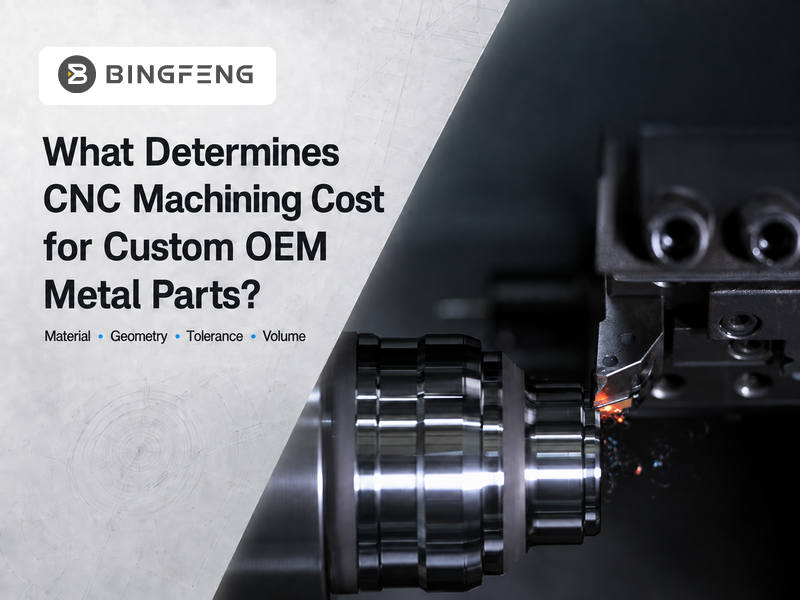
The cost of a custom CNC-machined component is not determined by material or machine time alone. Geometry, tolerances, production volume, inspection, heat treatment, surface finishing, tooling and delivery requirements all influence the final quotation.
For OEM buyers, understanding these factors makes it easier to prepare a complete RFQ, compare quotations fairly and avoid specifications that add cost without improving the part's function. Drawing on BING FENG INDUSTRIAL CO., LTD.'s experience in precision metal parts manufacturing and integrated processing, this guide explains how a manufacturer evaluates CNC machining cost for custom projects.
1. How Is CNC Machining Cost Calculated for an OEM Project?
A quotation normally combines several categories of cost rather than applying one universal price per hour. The manufacturer first reviews the drawing, material, quantity and quality requirements to determine a feasible production route. That route may include raw material procurement, blank preparation, programming, tooling, workholding, machining, inspection and coordinated secondary processes.
Setup work is especially important for a custom part. CNC programming, fixture preparation, tool selection, first-piece adjustment and inspection planning must often be completed before stable production begins. These costs are distributed across the order quantity, which is why a prototype and a repeat production order can have very different unit prices.
- CNC machining cost is the result of the complete manufacturing route, not machine time alone.
- Complete drawings and quantities allow the supplier to distribute setup costs more accurately.
2. How Does Material Selection Affect CNC Machining Cost?
Material affects the price of the raw stock, but its influence extends further. Strength, hardness, abrasiveness, thermal behavior, chip formation and dimensional stability can change cutting speed, tool selection, tool life and the number of operations required.
BING FENG works with materials that include high-carbon steel, alloy steel, stainless steel, copper, aluminum, titanium and cast iron. The most economical option is not always the material with the lowest purchase price. A material that machines slowly, causes rapid tool wear or requires additional heat treatment may create a higher total manufacturing cost.
| Material Factor | Possible Cost Impact | What Buyers Should Confirm |
|---|---|---|
| Raw stock form and size | Material utilization and removal volume | Required blank condition and available stock size |
| Hardness and strength | Cutting speed, tool wear and cycle time | Material condition before and after heat treatment |
| Dimensional stability | Machining allowances and corrective operations | Critical dimensions and treatment sequence |
| Traceability | Documentation and material control | Required certificates and inspection records |
When material substitution is permitted, indicate this on the RFQ. The manufacturer can then evaluate alternatives against strength, wear, corrosion resistance, machinability and final application requirements. Any substitution must still be approved against the engineering design.
- Compare material choices by total manufacturing cost, not raw material price alone.
- Specify the grade, initial condition, heat treatment and traceability requirements clearly.
3. Why Do Part Geometry and Machining Complexity Change the Price?
Two parts made from the same material can have very different machining costs. Features such as deep pockets, thin walls, long overhangs, internal corners, interrupted cuts, difficult tool access, multiple datum relationships and complex profiles can increase setup time and machining risk.
A part that can be completed in one stable setup may cost less than a simpler-looking part that requires repeated repositioning. Each additional setup can add handling time and create another opportunity for alignment variation. Specialized fixtures may be required for irregular-shaped components or for parts that must maintain close relationships between features on different faces.
BING FENG's manufacturing experience covers crankshafts, connecting rods, clutch gear sets, bevel gears, gear couplings, differential bevel gears, clutch bevel gears, gear shafts, spur gears, axles, long shafts, ATV rear axles, heavy motorcycle rear axles, drive shafts, eccentric components and various irregular-shaped precision parts. Actual feasibility and process selection are evaluated from the customer's drawing.
- Tool access, workholding and setup count can affect cost as much as the number of visible features.
- Sharing a 3D model with the 2D drawing helps the manufacturer review complex geometry.
4. How Do Tolerances, Surface Finish and Inspection Affect Cost?
Tighter tolerances require more than a precise machine. They may require a more stable setup, slower finishing passes, controlled temperature, additional measuring time, calibrated equipment and documented inspection. If tight tolerances are applied to every dimension, the part may become more expensive without receiving a corresponding functional benefit.
Engineering drawings should distinguish critical-to-function features from general dimensions. For shafts and rotating components, functional requirements may include diameter, concentricity, runout, straightness, bearing fits, gear engagement and surface condition. The correct inspection method depends on the feature and specified tolerance.
BING FENG uses quality inspection equipment that includes a ZEISS coordinate measuring machine. Inspection scope should nevertheless be agreed upon for each project, including sampling frequency, first-article requirements, reports and any customer-specific standards.
- Apply tight tolerances where they protect fit, function, sealing, motion or service life.
- Define surface roughness and inspection documentation only where required.
5. How Do Production Volume, Setup and Tooling Affect Unit Cost?
Order quantity changes how fixed preparation costs are distributed. Prototype and small-batch orders may have a higher unit price because programming, setup, fixture preparation and first-piece inspection are spread across fewer parts. As volume increases, dedicated tooling, optimized fixtures and process improvements may reduce unit cost.
Higher volume does not automatically guarantee the lowest total cost. The design must be stable enough to justify dedicated tooling, and annual demand should be realistic. If the drawing is likely to change, flexible tooling and smaller initial batches may reduce project risk even when the first unit price is higher.
Repeat orders can also benefit from stable material specifications, approved process records and established inspection plans. Buyers should provide both the initial order quantity and expected annual volume so the manufacturer can compare prototype, bridge-production and mass-production strategies.
- Provide prototype quantity, batch quantity and expected annual demand.
- Dedicated fixtures and tooling should be evaluated against design stability and repeat volume.
6. Which Secondary Processes Should Be Included in the Cost Review?
A finished OEM component may require more than CNC machining. Heat treatment can improve hardness, strength, toughness or wear resistance, while surface finishing may support corrosion resistance, appearance, friction behavior or durability. These operations can also affect dimensions, distortion, handling and inspection planning.
BING FENG provides integrated project support covering raw material procurement, tool development, process planning, precision CNC machining, heat treatment, surface finishing, quality inspection, packaging and logistics. The exact production route and whether individual operations are performed internally or through managed supply-chain resources should be confirmed for the specific project.
When several processes are involved, early planning helps determine machining allowances, treatment sequence, masking requirements, post-treatment finishing and final inspection. Quoting these requirements at the beginning is more reliable than adding them after machining has already been planned.
- Include heat treatment, surface finishing, inspection, packaging and logistics in the initial RFQ.
- Review the complete process sequence because secondary operations may affect final dimensions.
7. How Can Buyers Prepare a More Accurate and Cost-Effective RFQ?
An accurate quotation begins with complete information. Missing tolerances, material conditions or order quantities force the manufacturer to make assumptions, and different assumptions make supplier quotations difficult to compare.
Include the following information:
- Complete 2D drawing and 3D model when available
- Material grade and initial material condition
- Critical dimensions, tolerances, datums and surface roughness
- Heat treatment, hardness and surface finishing requirements
- Inspection method, sampling plan and report requirements
- Prototype quantity, batch quantity and expected annual demand
- Packaging, labeling, documentation and delivery requirements
- Final application and mating-component information when relevant
Cost reduction should focus on manufacturability rather than simply asking for a lower price. Useful discussions may include relaxing noncritical tolerances, standardizing raw stock, improving tool access, reducing unnecessary setups, confirming realistic inspection requirements and aligning batch size with demand.
- A complete RFQ improves quotation accuracy and reduces later revisions.
- The best value comes from balancing function, quality, lead time and total project cost.
8. Frequently Asked Questions
What is the biggest factor affecting CNC machining cost?
There is no single factor for every part. Material, geometry, tolerance, setup count, cycle time, inspection and production volume interact. For prototypes, setup cost can be significant; for production orders, material utilization and cycle time may have a larger influence.
Why does a prototype cost more per part than a production order?
Programming, setup, fixture preparation and first-piece inspection are distributed across only a few pieces. Larger repeat orders can spread these fixed costs across more units, provided the design and production process remain stable.
Do tighter tolerances always improve part quality?
No. A tolerance is valuable when it protects fit, function or performance. Applying unnecessarily tight tolerances to noncritical dimensions can increase machining and inspection cost without improving the finished assembly.
What information is needed for an OEM CNC machining quotation?
Provide the drawing, 3D model when available, material, tolerances, surface finish, heat treatment, inspection requirements, quantities, annual demand, packaging and delivery expectations. Final application information can help identify critical features.
Can BING FENG support both prototypes and production quantities?
BING FENG supports precision metal parts projects ranging from prototypes and small batches to mass-production programs. Feasibility, process selection, tooling and lead time are evaluated according to each drawing and project requirement.
Request a CNC Machining Project Review
Send BING FENG your drawings, material specifications, tolerances, quantities and secondary-process requirements. Our team will review manufacturing feasibility and the appropriate production route for your custom OEM metal parts.
Contact BING FENG