
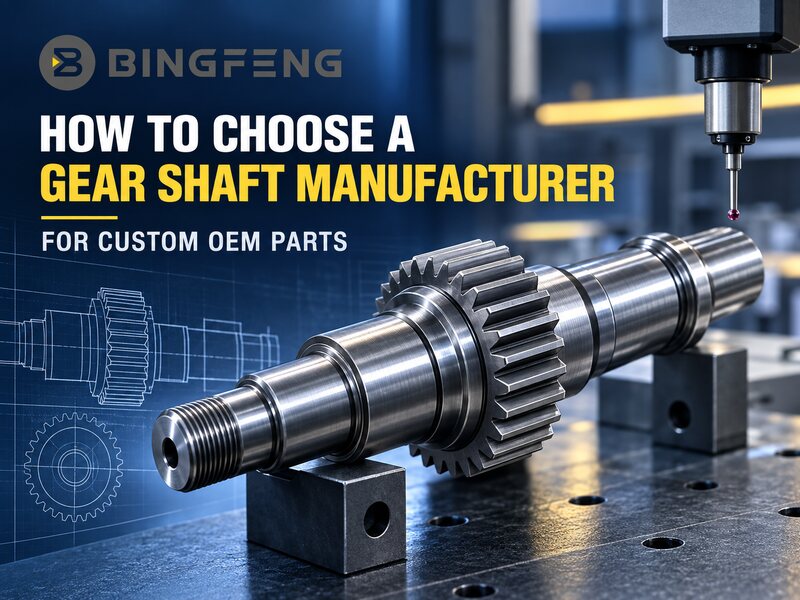
Choosing a gear shaft manufacturer requires more than comparing prices or reviewing a general equipment list. OEM buyers should confirm whether the supplier can understand engineering drawings, control the relationship between gear and shaft features, plan appropriate materials and treatments, verify critical dimensions, and support the project from prototype approval through repeat production.
A gear shaft functions as an integrated component. Its gear section, bearing journals, shoulders, keyways, splines, and mounting surfaces must maintain the correct dimensional relationship. A problem in one area may affect assembly, gear engagement, vibration, wear, or service life.
BING FENG INDUSTRIAL CO., LTD. manufactures gear shafts, bevel gears, spur gears, gear couplings, differential bevel gears, clutch bevel gears, and various precision shaft components. Drawing on our experience in precision metal parts manufacturing and integrated processing, this article explains what OEM buyers should evaluate before selecting a supplier.
1. What Should You Look for in a Gear Shaft Manufacturer?
A qualified gear shaft manufacturer should be able to evaluate the complete component rather than focusing only on the gear teeth. The supplier must understand how journals, shoulders, threads, keyways, splines, and other features relate to the gear section and the part’s rotational axis.
OEM buyers should begin by confirming whether the manufacturer can:
- Review 2D drawings, 3D models, and GD&T requirements
- Understand gear, shaft, and mating-component relationships
- Evaluate material, heat treatment, and surface requirements
- Plan machining, workholding, and measurement methods
- Support prototypes, small batches, and repeat production
- Maintain inspection records and batch traceability
- Coordinate the required secondary processes
The manufacturing plan should reflect the gear shaft’s operating torque, rotational speed, bearing locations, load conditions, and final assembly. Equipment alone cannot replace a clear understanding of these functional requirements.
BING FENG supports precision metal component projects ranging from small-batch prototyping to high-volume production. We review each inquiry according to its drawing, material, tolerance, quantity, and application rather than applying one standard process to every part.
- Evaluate the entire gear shaft, not only the tooth profile.
- Confirm that the manufacturer understands production and final assembly requirements.
- Make sure the supplier can support the project’s actual volume and quality expectations.
2. What Information Should You Provide for a Custom Gear Shaft Quote?
An accurate quotation begins with complete technical and commercial information. Missing material conditions, tolerances, or quantities may force suppliers to make assumptions, making quotations difficult to compare.
For a custom gear shaft project, the 2D drawing should identify the dimensions, tolerances, datums, surface conditions, and treatment requirements that govern production. A corresponding 3D model can help the manufacturer review complex geometry, but it should not replace the controlled drawing.
Gear Information
- Gear type
- Module or diametral pitch
- Number of teeth
- Pressure angle
- Helix angle, when applicable
- Tooth profile requirements
- Backlash or mating conditions
- Applicable customer or industry standards
Shaft and Project Information
- Journal diameters and bearing fits
- Shaft length, shoulders, grooves, and threads
- Keyway or spline specifications
- Material grade and initial condition
- Dimensional tolerances and applicable GD&T
- Surface roughness requirements
- Heat treatment and hardness requirements
- Effective case depth, when applicable
- Surface finishing requirements
- Prototype quantity, batch quantity, and annual demand
- Inspection reports and documentation requirements
- Packaging, labeling, and delivery expectations
Sharing the final application and relevant mating-component information can also help the manufacturer identify function-critical features.
- Submit a controlled 2D drawing and a matching 3D model when available.
- Clearly identify critical dimensions, treatments, and inspection requirements.
- Provide prototype, order, and annual quantities for realistic process planning.
3. Which Gear Shaft Specifications Are Critical to Performance?
Gear tooth geometry is important, but it does not determine gear shaft quality by itself. The relationship between the gear section, bearing journals, and other functional surfaces can be equally important.
For example, a bearing journal may meet its diameter tolerance but still be misaligned with the gear section. Depending on the assembly, this may contribute to uneven gear engagement, vibration, noise, bearing load, or localized wear.
| Specification | Why It Matters |
|---|---|
| Tooth geometry | Influences gear contact, load distribution, and engagement. |
| Circular or total runout | Helps control rotational variation between related surfaces. |
| Journal alignment | Supports the required relationship between journals and the rotational axis. |
| Journal diameter and fit | Affects bearing installation and rotational stability. |
| Cylindricity | Helps maintain a consistent journal or fitted surface. |
| Shoulder location and perpendicularity | Affects axial positioning during assembly. |
| Keyway or spline position | Influences torque transfer and mating-component alignment. |
| Surface roughness | May affect bearing fits, friction, sealing, and wear. |
| Backlash and mating conditions | Influence clearance, movement, noise, and transmission behavior. |
The appropriate GD&T control depends on the product design and the standard applied to the drawing. Circular runout, total runout, position, cylindricity, or other controls may be used according to the functional requirement.
Applying unnecessarily tight tolerances to every dimension can increase machining and inspection requirements without improving performance. Critical characteristics should be assigned to features that protect fit, motion, load transfer, and service life.
We review customer drawings and specified datum structures to plan suitable machining, workholding, and measurement methods. Final feasibility depends on the required feature, tolerance, and inspection standard.
- Gear shaft performance depends on the relationship between teeth, journals, and mounting features.
- Use appropriate GD&T controls based on actual function.
- Apply tight tolerances where they protect assembly, rotation, or service life.
4. How Do Material Selection and Heat Treatment Affect Gear Shaft Performance?
Material selection should begin with the gear shaft’s operating conditions. Torque, speed, impact, fatigue, wear, temperature, and required service life may all influence the appropriate choice.
Carbon steel may provide a practical balance of performance and cost for suitable applications. Alloy steel may be considered when the design requires higher strength, toughness, fatigue resistance, or heat-treatment response. Special alloy steel may be evaluated for more demanding operating conditions.
The final grade must be determined according to the customer’s design and performance requirements. A lower raw-material price does not necessarily produce a lower total manufacturing cost if the material requires slower machining, additional tooling, or more complex treatment.
Heat treatment may improve hardness, strength, toughness, and wear resistance, but it can also affect dimensions and part stability. The treatment sequence must therefore be considered before machining allowances and final inspection are determined.
Depending on the material, geometry, and tolerance, the production route may include rough machining, treatment, and subsequent finishing operations. This sequence helps account for dimensional changes that may occur during processing.
BING FENG provides heat-treatment and related performance-enhancement processes that include pressure vacuum quenching, vacuum carburizing, low-pressure nitriding, cryogenic treatment, and shot peening. These are available capabilities rather than a fixed sequence for every gear shaft. Applicable processes are evaluated according to customer specifications and project feasibility.
- Select materials according to operating conditions and engineering requirements.
- Evaluate strength, toughness, wear resistance, and fatigue performance together.
- Include heat treatment in the initial manufacturing and inspection plan.
5. How Are Custom Gear Shafts Manufactured from Blank to Finished Part?
There is no universal manufacturing route for every custom gear shaft. The appropriate sequence depends on the drawing, material, geometry, tolerances, required performance, and production volume.
A forging may be considered for suitable load-bearing parts where material flow and mechanical performance are important. A casting may be evaluated for certain complex geometries. The correct blank and production route must be determined from the complete project requirements.
Surface finishing may be specified to improve corrosion resistance, durability, appearance, or other functional characteristics. The appropriate option depends on the material and application.
- The production route must be planned around the complete gear shaft specification.
- Casting, forging, and secondary processes are used only when appropriate.
- Final inspection should follow processes that may affect critical dimensions.
6. How Can Buyers Verify Quality and Production Readiness?
A supplier’s capabilities should be verified through project-specific evidence rather than equipment lists alone. Before approving production, buyers should understand how critical characteristics will be manufactured, inspected, and documented.
For a new gear shaft, the approval process may include a first article or initial sample inspection. The customer and manufacturer should agree on the controlled drawing revision, critical dimensions, inspection methods, sampling frequency, required reports, material documents, and acceptance criteria.
BING FENG uses quality inspection equipment that includes a ZEISS coordinate measuring machine. We apply appropriate measurement control according to the drawing and agreed inspection scope.
Different gear and shaft features may require different inspection methods. A CMM or any other single instrument should not automatically be assumed suitable for every tooth, surface, or rotational requirement. The inspection method must match the specified characteristic and standard.
Evidence to Review Before Production Approval
- Approved drawing and revision
- Material specification and certificates
- First-article or sample inspection results
- Critical-dimension and GD&T reports
- Required hardness and surface-condition records
- Batch identification and traceability
- Approved process and inspection plan
- Packaging and labeling requirements
Moving from prototyping into repeat production may also require fixture preparation, tool control, defined inspection frequency, batch traceability, and change management. Expected annual demand helps determine whether flexible tooling or dedicated production resources are more appropriate.
BING FENG is ISO 9001 certified and supports small-batch prototyping and high-volume production. Actual capacity, tooling, lead time, and inspection arrangements are reviewed according to each project.
- Verify manufacturing capability through samples, reports, and an agreed control plan.
- Match the inspection method to the feature and specification.
- Confirm traceability and change control before repeat production.
7. Frequently Asked Questions About Custom Gear Shaft Manufacturing
What information is required for a custom gear shaft quotation?
Provide the latest controlled drawing, material and treatment requirements, critical tolerances, order quantity, and inspection expectations. A 3D model and mating-component information may also help the manufacturer evaluate complex geometry and functional relationships.
Can a gear shaft manufacturer support both prototypes and mass production?
Yes, provided the supplier has suitable process flexibility and production capacity. BING FENG supports small-batch prototyping and high-volume production. Tooling, inspection, capacity, and lead time are evaluated according to the drawing and expected quantity.
Why are runout and journal alignment important in gear shafts?
These requirements help control the relationship between the rotational axis, gear section, bearing journals, and other functional surfaces. Excessive variation may affect gear engagement, assembly, vibration, bearing load, or wear.
Should gear shafts be finish-machined before or after heat treatment?
The correct sequence depends on the material, treatment method, hardness, geometry, and final tolerance. Some projects may require rough machining before treatment and finishing operations afterward to achieve the specified final condition.
Can BING FENG manage heat treatment and surface finishing?
Yes. We provide integrated project support that includes CNC machining, heat treatment, and surface finishing. Applicable processes, sequence, and inspection requirements are confirmed according to each drawing and project specification.
Choosing the right gear shaft manufacturer begins with the specifications that determine how the component must fit, rotate, and transmit load.
BING FENG manufactures gear shafts and a range of related precision gear and shaft components. We support custom OEM projects with precision CNC machining, treatment and finishing options, quality inspection, packaging, and logistics.
Send us your latest drawing, material requirements, critical tolerances, production quantities, and application information. Our team will review manufacturing feasibility and propose an appropriate production route for your project.
Contact BING FENG