
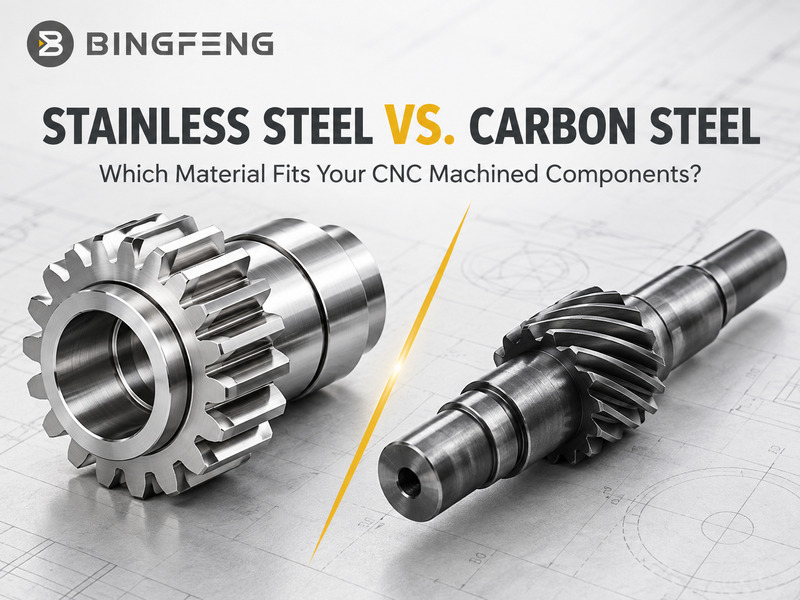
Stainless steel is generally considered when corrosion resistance, cleaning or surface condition is important. Carbon steel may be suitable when mechanical performance, heat-treatment response and cost control are higher priorities. The final choice must be based on the exact grade, material condition, operating environment and component function.
Choosing between stainless steel and carbon steel affects more than the purchase price of a component. Material selection can influence corrosion resistance, wear performance, machining conditions, surface treatment, maintenance requirements and long-term operating cost.
Neither material is automatically better for every application. At BING FENG INDUSTRIAL CO., LTD., we manufacture custom CNC machined components according to customer drawings and specified material requirements. Our services include casting and forging manufacturing, CNC machining, heat treatment, surface finishing, dimensional inspection and production planning.
1. Stainless Steel vs. Carbon Steel: A Quick Comparison
Stainless steel and carbon steel are broad material categories. Their actual properties depend on the selected grade, metallurgical structure, heat-treatment condition and manufacturing history.
Stainless steel contains sufficient chromium to form a passive surface layer that improves corrosion resistance. This makes it a common choice for components exposed to moisture, cleaning procedures or certain corrosive environments. Stainless steel is corrosion-resistant rather than corrosion-proof, so performance still depends on the grade, surface condition, temperature, contaminants and chemical exposure.
Carbon steel is generally economical and offers a wide range of strength, hardness and machining characteristics. Depending on the grade and condition, it may be considered for shafts, gears, structural parts and other general machinery components when corrosion resistance is not the primary requirement.
| Selection Factor | Stainless Steel | Carbon Steel |
|---|---|---|
| Corrosion resistance | Generally higher; depends on grade and environment | Generally lower unless protected by an appropriate finish |
| Mechanical properties | Vary by stainless family, grade and condition | Vary with carbon content, grade and heat treatment |
| Machining behavior | May require careful control of heat, tooling and work hardening | Machinability varies by grade, hardness and supplied condition |
| Heat-treatment options | Depend on the stainless-steel family | Depend on carbon content, section size and selected process |
| Surface protection | Passivation or another specified finish may be required | Coating, plating or another protective finish is often considered |
| Common selection priorities | Corrosion resistance, cleaning and surface condition | Mechanical performance, heat treatment and cost |
- Stainless steel is generally selected when corrosion resistance and cleaning requirements are important.
- Carbon steel may be considered for mechanical performance, heat-treatment response and cost control.
- Material family alone is insufficient; specify the exact grade and condition.
2. How Does the Operating Environment Affect Material Selection?
The operating environment should be evaluated before comparing machining cost or nominal material strength. Components exposed to water, humidity, cleaning agents, salt or chemicals may require a material selected specifically for the expected exposure.
Stainless steel may offer an advantage under these conditions, but the appropriate grade must still be selected. In dry or controlled environments, carbon steel may provide the required function at a more economical material cost. When corrosion protection is necessary, the drawing should specify the required coating or surface treatment.
Food-processing and packaging equipment require additional attention. Some components are exposed to moisture and cleaning, while others remain protected inside transmissions or mechanical assemblies. A part used in food equipment is therefore not automatically a direct food-contact component.
When a part will contact food, the buyer should define the applicable material, surface roughness, hygiene, cleaning, traceability and regulatory requirements during the quotation stage. We manufacture according to customer-provided requirements, but material selection alone should not be treated as confirmation of food-contact compliance.
- Identify moisture, chemical, temperature and cleaning exposure.
- Separate direct food-contact parts from non-contact equipment parts.
- Specify the required protection when carbon steel is used in a corrosion-sensitive environment.
- Do not assume every stainless-steel grade performs equally.
3. Strength, Hardness and Wear Resistance: What Does the Part Need to Do?
Material selection should begin with the function of the component. Shafts, gears, couplings, spacers, housings and irregular-shaped parts can experience different combinations of torque, impact, bending, fatigue, friction and wear.
Carbon steel is often considered for gears, shafts, structural parts and other general machinery components when corrosion resistance is not the primary requirement. Certain grades can be heat-treated to modify hardness and mechanical performance, but the result depends on carbon content, section size, geometry and the selected heat-treatment process.
Stainless steels also behave differently according to their metallurgical family. Austenitic stainless steels are widely selected for corrosion resistance but are not hardened through conventional quench-and-temper treatment. Martensitic and precipitation-hardening stainless steels provide different mechanical and heat-treatment characteristics.
For wear-critical parts, buyers should identify operating load, contact conditions, target hardness, required case depth where applicable and expected service environment. These details help determine whether the proposed material and treatment are technically suitable.
- Evaluate load, impact, fatigue, friction and wear.
- Compare properties by grade and condition, rather than material family alone.
- Heat-treatment response differs among steel grades and stainless families.
- State critical hardness and case-depth requirements on the drawing.
4. How Do Stainless Steel and Carbon Steel Differ in CNC Machining?
Material selection directly affects tooling, cutting parameters, chip control, workholding, process sequence, cycle time and dimensional stability.
Some stainless steels generate considerable cutting heat and can work-harden when cutting conditions are unsuitable. Machining may require appropriate tool geometry, stable fixturing, controlled feeds and effective coolant application.
Carbon steel is often considered machinable, but actual performance still varies with grade, carbon content, hardness, inclusions and prior heat treatment. A hardened carbon-steel part may require a different process route from the same grade supplied in an annealed or normalized condition.
Part geometry also matters. Thin walls, long shafts, deep bores, interrupted cuts, tight concentricity and strict runout requirements may affect deformation control and machining sequence regardless of material.
At BING FENG, we manufacture custom CNC-machined metal parts based on customer drawings, GD&T, material specifications and special process requirements. Our CNC turn-mill capabilities support complex geometries and multi-step machining, while inspection planning helps verify critical dimensions and assembly requirements.
- Machinability depends on material grade and supplied condition.
- Stainless steel may require careful control of heat and work hardening.
- Carbon-steel cutting conditions change with grade and hardness.
- Evaluate geometry, tolerances and production quantity together.
5. Why Material Grade and Heat Treatment Condition Must Be Specified
Writing only “stainless steel” or “carbon steel” on an RFQ is normally insufficient. Grades within the same category can have substantially different corrosion resistance, hardness, strength, welding characteristics and machining behavior.
Even the same grade may perform differently depending on whether it is supplied in an annealed, normalized, cold-worked, quenched-and-tempered or another specified condition.
The drawing and RFQ should identify:
- Material standard and grade
- Required delivery condition
- Heat-treatment process, when applicable
- Target hardness or hardness range
- Case depth, when required
- Surface treatment or coating
- Surface roughness requirements
- Material certification or inspection documentation
- Applicable customer or industry specifications
BING FENG’s heat-treatment and related processing capabilities should be evaluated against the specified material, geometry, performance target and drawing requirements. The selected process and acceptance criteria should be confirmed during quotation and production planning.
Surface finishing should also be specified carefully. For example, black oxide alone provides limited corrosion protection and may require appropriate sealing or additional maintenance depending on the application. Plating, coating, passivation or another treatment should be selected according to the actual environment and function.
- Specify the exact material grade and supplied condition.
- Match heat treatment to the material and performance requirement.
- Do not use a surface treatment as a substitute for correct base-material selection.
- Include inspection and documentation requirements before quotation.
6. How to Make the Final Material Decision
The best material is the one that satisfies the component’s functional, environmental, manufacturing, maintenance and commercial requirements. It is not necessarily the material with the highest strength or corrosion resistance.
Food Equipment Components
Stainless steel precision components may be appropriate for parts exposed to cleaning or moisture when the selected grade and surface requirements match the equipment design.
Carbon steel may still be considered for protected or non-food-contact mechanical parts when the drawing and operating conditions permit it.
General Machinery Components
Carbon steel may be suitable for shafts, gears, supports and transmission components operating in controlled environments.
Stainless steel may be preferred when corrosion, cleaning or surface-condition requirements justify the added material and machining considerations.
Before requesting a quotation, provide:
- 2D drawings and available 3D models
- Material grade and supplied condition
- Critical dimensions and GD&T requirements
- Required hardness and heat treatment
- Surface finish or coating
- Operating environment
- Food, chemical or moisture contact where applicable
- Inspection and documentation requirements
- Prototype and estimated production quantities
- Packaging and delivery requirements
Complete information allows us to evaluate manufacturing feasibility, machining sequence, inspection planning and applicable secondary processes more accurately.
- Balance component function, environment, production and maintenance.
- Do not select material based on price alone.
- Identify direct-contact, wear-critical and corrosion-critical surfaces.
- A complete RFQ reduces assumptions and improves quotation accuracy.
7. FAQ: Stainless Steel and Carbon Steel CNC Machining
Is stainless steel always better than carbon steel?
No. Stainless steel generally provides higher corrosion resistance, while carbon steel may be more suitable for mechanical performance, heat-treatment response or cost control. The decision should be based on grade, condition, environment and component function.
Is stainless steel harder to machine than carbon steel?
Not in every case. Some stainless steels require closer control because of work hardening, cutting heat or chip behavior. Machinability varies significantly across both stainless-steel and carbon-steel grades.
Can carbon steel be used for food-equipment components?
Carbon steel may be considered for protected or non-food-contact components if the equipment design and customer requirements permit it. Direct food-contact parts require evaluation of the specified material, surface condition, cleaning process and applicable regulations.
Can heat treatment improve carbon-steel performance?
Depending on carbon content, material grade, geometry, section size and the selected process, heat treatment can modify hardness, strength, toughness and wear performance. The required condition should be defined on the drawing.
Does stainless steel require surface finishing?
It depends on the application. Passivation, polishing or another specified finish may be required to achieve the necessary surface condition, appearance, cleanability or corrosion performance.
What information does BING FENG need for a quotation?
Please provide drawings, material specifications, tolerances, quantities, heat-treatment requirements, surface finishing, inspection standards and operating conditions. These details allow us to evaluate production requirements without making assumptions about the intended use.
Choose the Material Based on the Application
The choice between stainless steel and carbon steel should be based on the complete component specification. Corrosion resistance, mechanical performance, machinability, heat treatment, surface protection, maintenance and total cost should be evaluated together.
At BING FENG INDUSTRIAL CO., LTD., we manufacture custom precision metal components according to customer drawings and specifications. Our capabilities cover casting and forging manufacturing, CNC machining, heat treatment, surface finishing, dimensional inspection and production planning.
Send us your drawing, material requirements, operating conditions and expected production quantity. We can evaluate the manufacturing requirements and prepare a quotation based on the information provided.
Discuss Your Custom Component Requirements